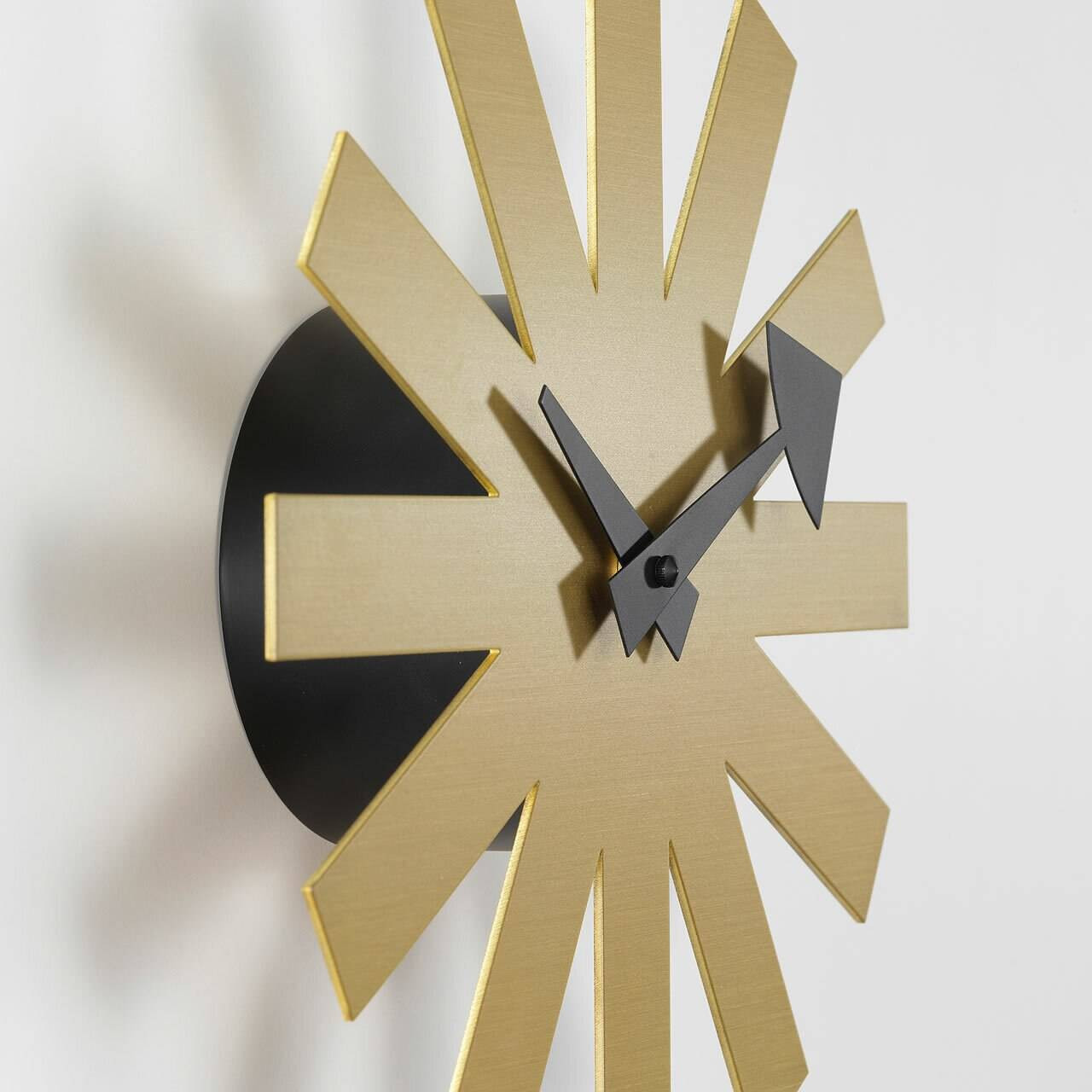

Asterisk Clock is the typographer’s star made into a clock: a solid asterisk just under ten inches across, with the hands turning at its center. George Nelson’s studio designed it for the Howard Miller Clock Company around 1950, and it appeared in the catalogue as Model 2213. The word comes from the Greek for “little star,” and for centuries the mark has signaled that there is more to notice. On the wall, the mark itself becomes the point of emphasis. Like every Nelson clock, it has no numerals; the arms of the asterisk give the hands their bearings. Vitra has made it since 1999 from drawings in Nelson’s archive.
HOW THE ASTERISK CLOCK WORKS
A German quartz movement at the center runs on one AA battery, included. You read the time by where the hands point against the arms. A knob on the back sets the time, and the clock hangs from a keyhole like the other Nelson wall clocks. It is the smallest of the Nelson wall clocks, and at about two and a half pounds, heavier than its size suggests.
CHOOSING YOUR GEORGE NELSON CLOCK
There are two editions of the same form. Black is powder-coated steel with white hands, the more graphic of the two and the one with the strongest contrast on a light wall. Brass is solid brass with black hands and a warmer presence. Both are custom ordered; lead times from Vitra vary, so ask us for the current one if timing matters.
DEALER’S NOTES
Most people find the Asterisk smaller than they expected, and that is part of what makes it useful. It works on walls the larger Nelson clocks can overwhelm: beside a doorway, over a desk, in a kitchen or hallway, anywhere it will usually be seen from a few feet rather than across a room. What we like is the combination of graphic shape and solid construction; despite its size, it has real weight in the hand and works comfortably in both modern and mid-century interiors.
The movement is the same type used in the other Nelson wall clocks and is straightforward to replace with parts from us and our guide. Authentic examples carry the Vitra label and use a German movement. We have sold Vitra’s Nelson clocks since 2020 and inspect each one before it ships.
Quick Help & Manual
Setting the time
The best way is the dial on the back: turn it so the hands move clockwise. Turning it counterclockwise is fine for setting the hour back in the fall. If taking the clock down is awkward, you may also move the minute hand directly, gently and clockwise. Never move the hour hand on its own; it can damage the gears and put the hands out of sync. The one risk in moving the minute hand is loosening the small nut (open or closed, depending on the model) that holds it in place; a loose nut can eventually let the minute hand come off. If that happens, we sell replacement nuts and hands, and the fix takes a minute.

Replacing the battery
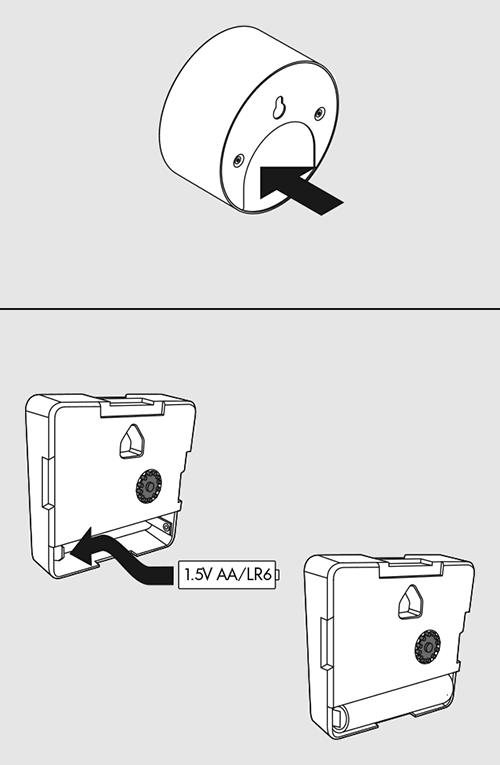
All wall clocks run on a single AA 1.5V battery, which is included. The flat negative (−) end goes against the springier of the two contacts on the movement: angle that end in first, then press the battery down. We prefer Duracell, Duracell Procell Constant, or Energizer Ultimate Lithium (non-rechargeable), which is leak-proof. Replace the battery as soon as the clock starts losing time, or better, make it an annual routine at the spring or fall time change; the old battery is usually still good for a remote or another device.
Cleaning
Gently dust with a feather duster or microfiber cloth. Be careful not to knock the clock off the wall. Occasionally blow dust from the movement shaft to prevent buildup. To clean stains, lightly dampen a microfiber cloth with a very diluted mild, non-abrasive detergent, and promptly dry. Contact us about any stubborn stains or mechanical issues.
Extending the life of the movement
The clock movement is easily replaced (see Hand / Movement Replacement Guide), but with good care it lasts 10–25 years. Change the battery once a year; the fall or spring time change is a good reminder. Keep dust from building up on the hands and the movement shaft. Keep the clock out of strong sun and heat. Set the time with the dial on the back whenever you can, and if you move the minute hand instead, keep a light touch and leave the hour hand alone.
Warranty & Repairs
George Nelson clocks made by Vitra are guaranteed against defects under normal use for 2 years from the date of purchase, parts and labor. Clock Forward covers the movement for 3 further years, parts only. If a replacement part doesn’t solve the problem within the warranty, a full replacement may be authorized. Normal wear is not covered.
We stock replacement movements, hands, and nuts for Vitra-made George Nelson clocks only. Please contact us with any problem for as long as you own the clock, in or out of warranty.
George Nelson Clock Updates
Recommended:
Get an email reminder during spring and fall time changes on how to set your clock.